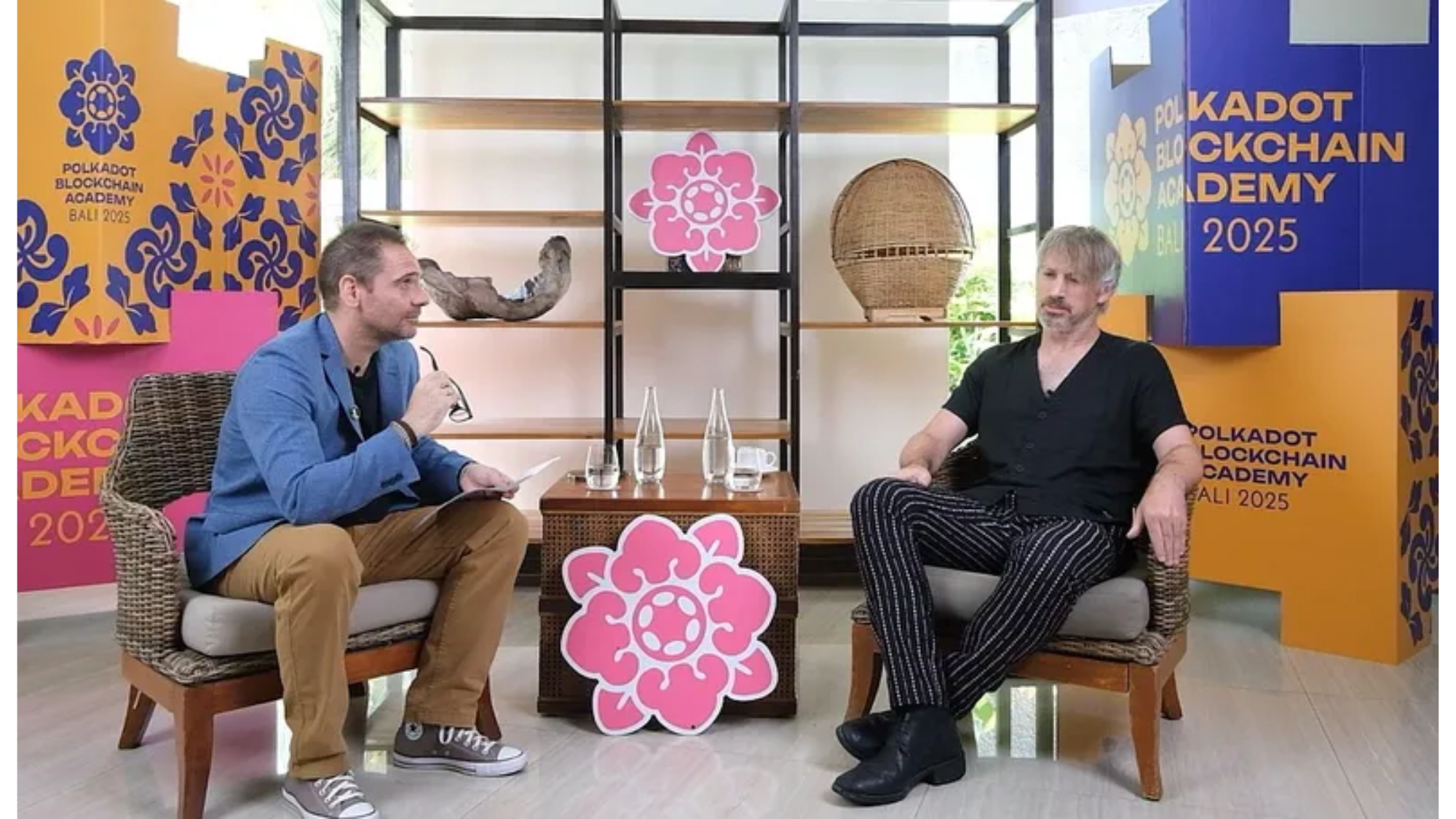
We have been listening recently about JAM's next launch, something that you defined as a "universal computer." Can you explain exactly what this is about?
It's essentially an update of Polkadot, that will allow, beyond technical details, that many more applications can be mounted on our platform and, moreover, will make it possible for more people to understand our technologies.
As you know, this is a crucial point, and that's partly why we have been leading this academy - Polkadot Blockchain Academy. We need more developers to learn how to use our protocol and with JAM - Join- Accumulated Machines - we will be encouraging more independent programmers, students and practitioners to adopt the type of code I wrote.
Those who are encouraged to use this new technology will get great rewards, and that's how we try to mass the use of this innovation.
Speaking about the adoption of technology, statistics show that Blockchain users are between 300 and 500 million worldwide. Do you think as long as Blockchain continues to be associated with cryptomonedas and speculation, we will not see a truly massive adoption?
Absolutely. That's why, since I founded Parity Technologies a decade ago, I have been working to develop solutions by thinking about the remaining 8 billion - she laughs.
It happens that we all know about Blockchain's potential, but it's still a difficult technology for what you usually call "regular people." Now, in turn, these people are losing confidence in democracy. Do you think that independent and decentralized organisations - DOS - can be an answer to today's crisis of confidence?
Yeah. I mean, there's a couple of reasons I'm still trying to innovate with technology. On the one hand, my aim is to create technological solutions that better make my life and, if possible, that of others. But in a way, I do as well because I think today the world needs this new way of designing technological products.
We had this in mind when I was born, in 1980. But really, applications and platforms determine how we link with society. They, in turn, feed on how we use their solutions massively. Even with Artificial Intelligence today, we continue to talk about algorithms that feed on information we give them.
Now, if we think about banks or companies, today we know that their most valuable asset is the network they have built - they mean their customers - but they are always these entities in the middle, as an axis of every link between human beings and they are always human beings feeding them.
Clearly we have to assume that there's currently a version of what philosophers hundreds of years ago called "social contract." Let's say our current society looks like a number of intertwined social contracts.
I'll give you an example. Please note that we have often signed a ten-page license contract with technological products and that these clauses cannot be clearly explained even by a lawyer if they have been put to trial.
Is it reasonable we have to do this? No, of course. Especially because, as described above, this re-validation of social contracts remains opaque and unintelligible to citizens, who, if they demand clarity, run the risk of being out of the system.
And I think that's what contributes to the disappointment people have today. That's why the technology I'm building I think brings clarity and minimizes how many rules we have been put into place.
It's clear that you're trying to create technologies that get middlemen from us but don't you think it's hard for people to figure out a society without these middlemen, who are ultimately governments or companies?
Yeah, I totally agree. It's complicated to imagine, as we navigate calm waters. Today, however, this isn't reality. The waters are scrambling, and I think people are opening their eyes, ready to prove new things.
Also, paraphrasing a thinker whose name I don't remember now, it's foolish to change the system by fighting with him. Instead, it's far better to create a new paradigm and let things evolve and eventually continue their path to disappearance.
That sounds clever. Returning to governments, I suppose you are aware that recently the American parliament passed the Genius Act, with which it regulates the use of stablecoins. How do you analyze the use of this class of cryptomonedas and how do you think about this type of public sector actions?
Well, I have the impression that some rulers have good intentions, some are ignorant, and then there are those who seek to benefit them and their families - laughter.
Now, the stablecoins issue is interesting. From my point of view, that type of cryptomoneda offers an escape from the traditional financial system.
They are, let's say, an intermediate point, because they are about Blockchain, but they are tied to the value of currencies such as the dollar or the euro. When transacted with stable coins there's less friction - Commissioners - more freedom for the individual that has them, usually.
Now, I would say that, actually, this last one's questionable when you compare it with using a $20 bill, in the sense of how cash works. Because at the end of the day a $20 bill cannot be blocked or expropriated by middlemen, but a stable crypt account can be blocked and money expropriated.
At the end of the day, we have to remember that what politicians call stablecoins, usually, is nothing but a bank account, with the difference that instead of using your manual signature or a standard identification you use a cryptographic key.
In that sense, our Web 3 philosophy is that individuals have to become agents -N of R: Wood uses the term 'agency' and 'agent' that, in British philosophical tradition, refers to what we usually understand as Subject, in the sense of the individual who makes decisions with freedom and responsibility.
So, when we use something as a Udt or an Udg, instead of a Bitcoin, for an example of pure crypt, we're actually giving that power back to the bank, because, as I said, and perhaps not a lot of people know that, the Bank has the capacity to arbitrarily block or expropriate Udg and Udt by using user and anti-washing procedures.
Now good. If we talk about cryptomonedas whose stability comes from pure cryptography, that's to say, the algorithmic (known as DAI), then there's something different about them, because they cannot be expropriated by any banks.
Anyway, I would like to emphasize that, for me, if someone wants to use Udt as an improved bank account, say, it's okay from a practical point of view. But are you contributing to a better world? No.
It's clear that you look at things in a broad context, and in fact it was a great surprise to hear about this two days ago -N from R: Wood gave a talk for attendees to the Polkadot Blockchain Academy meeting. So I have one last question. We are in Bali attending the remarkable event of Polkadot Blockchain Academy, where techologists and leaders from 39 countries are actively learning how to use lockchain. And we also see the Indonesian government as an example of digitalization in the Asia Minor region. From a global perspective but focusing on underdeveloped countries, such as those of Latin America, what challenges do you currently face in terms of governments and technologies?
Generally, in my experience, politicians are trying to maintain the status quo. They're there to keep people happy. That begets a particular mindset, unfortunately, that's especially technophobic, because technology means change and change brings risks, and that brings us closer to failure and people stop being happy.
Technology innovation always involves some level of risk, so it doesn't seem that politicians will be leading this type of initiative, but sometimes bureaucrats have technology counselors who, even in favor of maintaining power, advise them to use some technologies.
What happens is that those technologies they advise are generally at least 30 years old, because technologies that advise governments are usually old people - they smile and apologize for stereotype.
I had, as a matter of fact, an experience with that. A few years ago I worked in military technology for a short period and met those in charge. They were good people, but they aren't the ones that will make a true difference to citizenship.
Let's put an example: Google launched his solution portfolio about 20 years ago. If the same product technology had been incorporated at that time, by the State, to simplify the payment of taxes, or to obtain a driver's license, or to issue a vote have been an extraordinary experience for society! But at that time, Google was new, so nobody in the government was willing to innovate that way.
The disconnect from that time between rulers and those who worked at Google creating solutions I think that's more or less the same as today that exists between governments and Web 3 technologies, and my job is to create bridges that will allow civil society and governments to adopt technologies that I build, and that may be seen as risky even though they have been sufficiently tested, to the point that at Polkadot there have been no attacks to the more than 6 billion dollars that are there at Dots.
Nevertheless, I have to be fair about this and the truth is that at the term lake I do not see incompatibility between governments and technologies. Indeed, I would like to highlight Singapore's experience, for instance, with whose leaders I have contact with.
But in general, the use of this technology I know involves some efforts from me and especially from education. That's related to Polkadot Blockchain Academy, because that's how we show decision makers why it's best to use this technology.
Mr. Wood, once again, I thank you for your time and your kindness.
It's been a pleasure.