“Today, DAOs — decentralized autonomous organizations that operate on blockchain — are plutocracies.” It was not the only strong statement Primavera De Filippi made in our interview, but it is a good place to begin.
De Filippi, a lawyer and academic who works at Harvard, is one of the most recognized researchers in the relationship between law and technology.
I interviewed her in November 2025, during the launch of Indonesia’s official blockchain. Moving away from the optimism that prevailed in Bali, she said that technology without regulation is useless, or even dangerous.
We learned something similar in the early days of AI, when State v. Loomis became relevant in 2016: if software created by a company cannot be fully explained by its own programmers — and therefore no human being can be held responsible — then society cannot treat its outputs as statements of truth.
Put differently, without responsibility there is no freedom. This is why we began to point to algorithmic governance as one of the central questions for democracy today.
In fact, in this part of the world, freedom is managed through a complex system that balances capitalism and democracy.
Until recently, law schools taught United States v. AT&T as a leading case and a clear example of that balance.
Interestingly, in the country that places economic growth and capital creation above almost everything else, the courts decided in 1982 that a telecommunications company had to be divided into seven parts because it was abusing its dominant position. It had become a monopoly.
Even so, now that Big Tech companies dominate communication — and by “communication” I mean every kind of symbolic exchange — abuse of a dominant position, among other harms, is quite clear. Consider these examples:
Google/Alphabet. In the United States, a court concluded in 2024 that the company had illegally maintained a monopoly in search and related advertising through distribution agreements and payments to be the default search engine. In 2025, another court found that it had monopolized advertising technology markets for the open web.
Google/Alphabet in Europe. The European Commission sanctioned the company in 2017 for favoring Google Shopping over competitors, for the conditions imposed on manufacturers using Android, and for restrictions linked to AdSense.
Meta/Facebook. In 2021, the U.S. Federal Trade Commission argued that the company had illegally maintained its monopoly in personal social networking through a “buy or bury” strategy targeting competitors, especially through the acquisitions of Instagram and WhatsApp.
Microsoft. From 1998 to 2013, courts in both Europe and the United States found the company liable for the way it imposed additional products after Windows was installed.
In the field of generative AI, or GenAI, the business is also concentrated in a few hands. Its productive, commercial and financial structure includes Big Tech companies as investors, customers and providers at the same time.
Taking Anthropic as an example, these circular agreements for the purchase of computing capacity work like this: Amazon and Alphabet not only invest billions of dollars in the lab. Anthropic then commits even larger sums to buying computing capacity from them. Amazon increased its total investment and agreed to contribute up to US$25 billion, while Anthropic committed to spending more than US$100 billion on AWS over ten years. At the same time, Alphabet agreed to invest up to US$40 billion, and Anthropic reportedly made commitments worth US$200 billion to Google Cloud and its chips.
Anthropic and OpenAI, the company behind ChatGPT, plan to go public in the final quarter of 2026, and their valuations are expected to triple. Anthropic is currently valued at an estimated US$965 billion.
Anthropic and OpenAI, like Google with Gemini and other companies in the field, use the same adoption strategy: extraordinary technological disruption supported by private capital that can absorb enormous losses until they take control of the market. This model is known as “winner takes all.”
Once they become so large that no law can stop them and no fine can hurt them, they begin to recover the money invested. They raise subscription prices, capture data and partner with governments.
This is what Big Tech companies did.
Legally Recognized Non-Human Entities in the United States
Before continuing, it is necessary to clarify that DAOs are non-human entities because their contracts are executed automatically, without human intervention, on blockchain. AI, in turn, is understood here as any computer system capable of learning and making decisions without human intervention, whether or not it operates on blockchain.
In the context described above, would democracy benefit if a state granted legal personhood to non-human entities?
Let us return to the idea of responsibility.
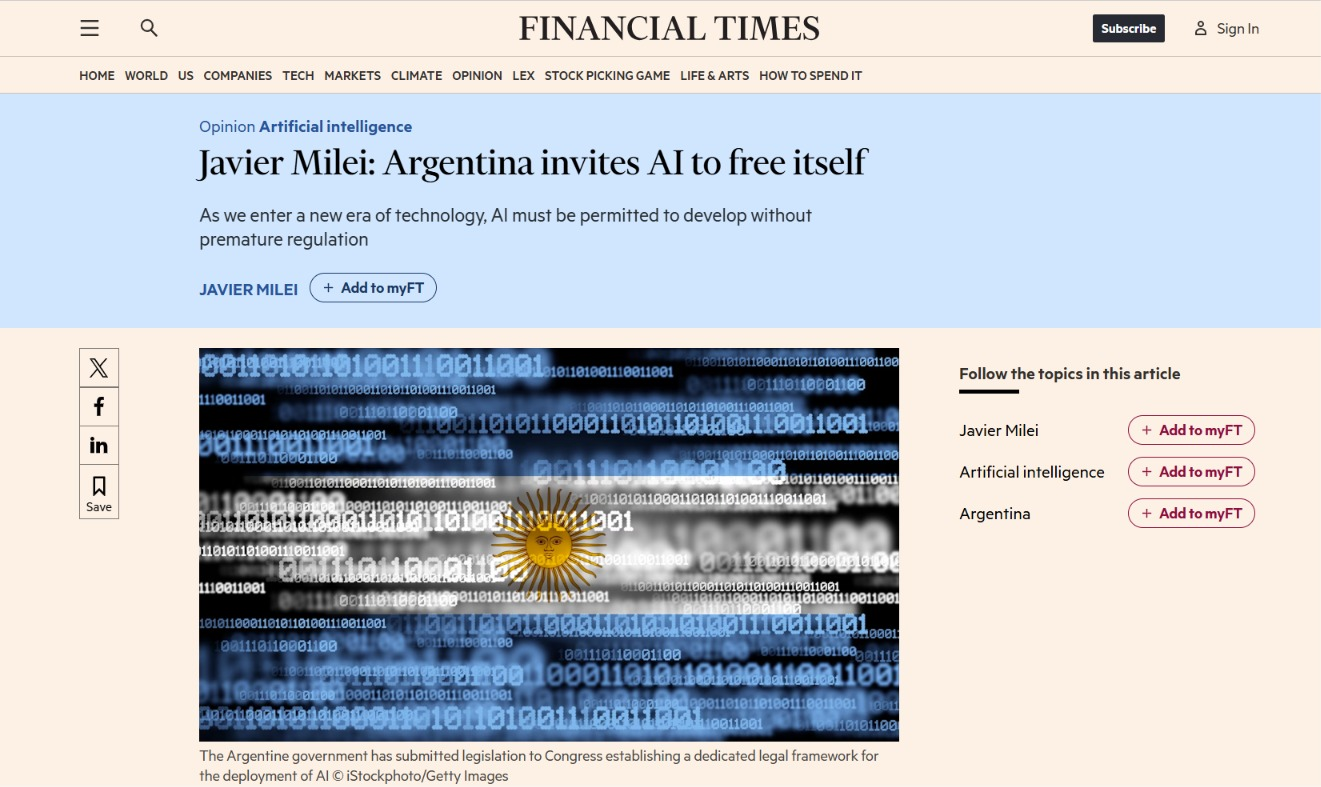
In his Financial Times article, Milei says that his proposal takes the creation of limited liability companies, or LLCs, as a model. In Argentina, the closest equivalents are the Sociedad de Responsabilidad Limitada, or SRL, and the Sociedad Anónima, or SA.
There is no doubt that creating a legal entity as an economic actor means that liability before the courts can be covered with the assets of that entity. But when those assets are not enough to compensate for the damage, the law normally makes it possible to identify the human being responsible for the decisions and hold that person liable with their own assets.
In the case of DAOs, it is extremely difficult to determine who makes decisions and how. This begins with the fact that anonymity is the most valuable feature blockchain offers to those who transact on it.
However, De Filippi co-authored a regulatory model adopted in 2024 by the state of Utah, and later by Wyoming and Tennessee in the United States. In short, under that framework, DAOs have legal personhood and operate as follows:
- They can be sued;
- They must have identifiable assets;
- They must have at least one human legal representative;
- Limited liability does not apply in cases of personal wrongdoing, bad faith or disobedience of a court order.
In addition, blockchain activity can be audited because the code is always visible. Regulators in those states believe that this transparency helps offset the following risk: if a DAO loses all its assets, and no member personally committed an illegal act or voted to disobey a court judgment ordering compensation, the injured party may receive nothing.
Of course, this risk also exists with companies run by human beings. But it is greater in DAOs because they have no board of directors, and being a beneficiary or a token holder does not make someone legally responsible.
Meanwhile, the U.S. government recently urged Anthropic to prevent foreign users from accessing its two new AI models, Mythos and Fable, because it considers them a threat to national security.
The Trump administration and the company are also involved in a court dispute that began earlier in 2026, after the creators of Claude refused to provide their AI for certain military purposes and domestic cyber surveillance.
Even so, leading analysts say that the risk of losing control of AI is real. Anthropic itself has publicly called several times for some form of joint oversight between the state and private companies.
In one of its latest blog posts, the company says: “If AI unlocks even a fraction of its potential, we will see unprecedented abundance (...) The challenge for the economy will not be how to drive growth, but how to ensure its distribution.”
To contribute to a solution, Anthropic has announced investment in applied research aimed at protecting jobs. It has also proposed regulatory frameworks for AI in general and for the economic policies needed in this new scenario, “because AI is advancing exponentially, while bureaucratic processes were designed for a slower world.”
The company also stresses that governments must have the power to demand transparency from developers and to prevent products from reaching the market without proper review.
All this suggests that deregulating technological development does not seem to benefit society as a whole.
Even the president of the United States, who initially argued that government should not interfere with technological innovation, is now using the power of his office to stop a development he considers dangerous for the country he governs.
At the same time, Anthropic’s proposal for AI co-governance is only one example. It makes clear that, if technology is to benefit society, democratic institutions and the law must play a central role.
In his Financial Times article, Milei argues that AI should not be regulated. He then says that he will send to Congress a legal framework that would incorporate entities managed by robots or AI through a reform of corporate law. He also proposes a “competitive tax environment.” The objective is clearly to attract foreign investment.
Two points emerge from this analysis. First, the examples of Utah, Wyoming and Tennessee — together with the failed experiments in Estonia and elsewhere in Europe — give us no reason to believe that the scenario Milei describes would benefit Argentina.
The risk is too great, and identifying who is responsible becomes almost impossible. In addition, the flow of crypto money is not transparent, and the knowledge economy does not create enough jobs. Hiring software workers in Argentina is currently expensive compared with India, Pakistan or the Philippines, for example, where companies hire more software workers.
As the people leading Anthropic have noted, today’s challenge is to distribute wealth created without human labor. As we have seen, for now that wealth flows toward a small number of immensely powerful companies.
Second, democracy, understood as a system of political and social organization aimed at correcting the imbalances of capitalism, always requires strong rules and institutions.
The courts keep the system in balance. But without human beings who can be held responsible — because the ultimate beneficiaries of artificial corporations are not necessarily responsible — the courts have no one to hold accountable.
De Filippi says: “Law is what gives democracy its structure. When we talk about new technologies, it needs clear points of intervention in order to guarantee governance.”
The strongest and most prestigious Spanish-language institution in AI regulation is the Innovation and Artificial Intelligence Laboratory at the University of Buenos Aires, known as UBA IALAB.
A year ago, that institution published Agentes de Inteligencia Artificial y Workflows Agénticos (Artificial Intelligence Agents and Agentic Workflows). The publication anticipated the level of automation we are seeing today. It argued that, depending on their risk and impact on society, artificial entities should use the human-in-the-loop model. In other words, human beings should participate actively in their decision-making processes.
The same idea appears in Organizaciones Centauro (Centaur Organizations), published in September 2025. The authors recognize that the new era of organizations that process information requires far fewer employees. But they argue that human beings must remain curators, designers, directors and strategic auditors of autonomous systems.
Plutocracy — the word De Filippi used at the beginning of this article — means government by the rich.
Blockchain attempted to renew the internet and return it to a space of absolute freedom, without government. The result is that DAOs today are controlled by those who hold the most tokens — in other words, the largest amount of crypto wealth.
In unequal countries such as Argentina, democracy is the last refuge of those who have the least against economic power. Without rules, and without human beings who can be held responsible and made to pay for harm, red lights start flashing everywhere.
It is not sensible for non-human entities to gain autonomy without oversight. It is even less sensible to give money legal status without real people who can be held responsible.
Democracy weakens when there is freedom without responsibility.